When Rhode released a silicone phone case designed to hold its Peptide Lip Treatment, it did not present the product as a stunt. There was no loud tagline announcing disruption. There was no overproduced reveal. Instead, the brand allowed the object to surface quietly in the hands of its founder, Hailey Bieber, long before it was formally introduced.
The internet did the rest.
What unfolded was not accidental virality. It was structural marketing precision.
The Foundation: Identity Before Product
Rhode’s success with the phone case only makes sense when viewed against the brand’s prior groundwork.
For years, Hailey Bieber had cultivated a public identity rooted in skincare discipline and minimalist beauty. Her “glazed” aesthetic circulated widely across TikTok and Instagram, shaping how Gen Z and young millennials thought about dewy skin, lip gloss, and clean routines. This meant that when Rhode launched, it entered a market already primed to associate the founder with skin credibility.
Trust was pre-installed.
By the time the phone case appeared in paparazzi photos and mirror selfies, the audience did not question whether Rhode belonged in their routine. The only question was how to get it.
The Product Insight: Merge Behavior With Visibility
Lip balm is used constantly.
Phones are held constantly.
Rhode fused the two.
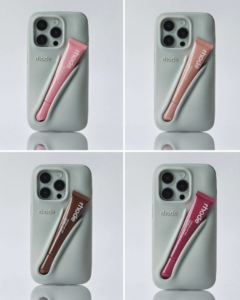
The phone case was designed with a molded compartment that snugly held the Peptide Lip Treatment. It converted a small, frequently misplaced cosmetic item into a permanent extension of the most visible object in modern life.
This move accomplished several things simultaneously:
-
Increased usage frequency
-
Increased brand visibility
-
Reduced product friction
-
Turned private grooming into public signaling
The case did not simply carry lip treatment. It carried brand identity into every selfie, every TikTok, every mirror photo.
This was distribution without paid placement.
The Rollout: Curiosity as Fuel
Before Rhode ever confirmed the product, Hailey appeared using a prototype. Fans zoomed in. Comment sections flooded with questions. Beauty accounts speculated.
There was no formal announcement. No hard sell. Just repeated, casual exposure.
This created a demand inversion. Instead of pushing awareness outward, Rhode allowed curiosity to build inward. The audience requested the product before it was offered.
When the official drop was announced, it felt like access granted rather than inventory released.
Scarcity then amplified the effect. Limited quantities sold out quickly. Screenshots of “sold out” pages circulated across social platforms, serving as social proof. Scarcity triggered urgency. Urgency triggered comment velocity. Comment velocity triggered algorithmic amplification.
The mechanics were simple but disciplined.
Visual Strategy: Designed for the Feed
The phone case was not flashy. It came in neutral tones aligned with Rhode’s broader aesthetic language: muted beige, soft grey, pale blush. These shades blended seamlessly into minimalist Instagram grids and clean TikTok backdrops.
Nothing about the product disrupted personal branding. It integrated with it.
In mirror selfies, the case was perfectly framed. The Rhode logo remained legible. The lip treatment slot was obvious but not bulky. The object felt intentional in close-up shots.
This is where the campaign reveals its true sophistication. The product was engineered for digital optics. It was built to look good at arm’s length in vertical video.
Most brands design for retail shelf appeal. Rhode designed for handheld photography.
Participation Loop: Consumers as Media
Once customers received their cases, the content ecosystem expanded organically:
-
Unboxing videos
-
Color comparisons
-
GRWM integrations
-
“What’s in my bag” breakdowns
-
Outfit coordination posts
The product was inherently demonstrable. It required no explanation. Viewers could understand the value proposition within seconds of seeing it used.
This reduced cognitive load and increased shareability.
Every customer became a micro-distribution node.
Economic Implications
From a business standpoint, the phone case achieved three key outcomes:
-
Increased Average Order Value
Consumers often purchased the case alongside multiple lip treatments. -
Increased Lifetime Value
Because the product was physically attached to the phone, reapplication frequency increased. Higher usage leads to faster depletion. Faster depletion drives repurchase. -
Reduced Paid Media Dependency
The constant organic visibility reduced reliance on aggressive ad spend.
The product itself functioned as media.
Cultural Timing
The campaign landed during peak routine culture on TikTok. GRWM content dominated feeds. The clean girl aesthetic favored subtle accessories and skin-first beauty. Modular lifestyle products were gaining traction.
Rhode did not attempt to redirect culture. It aligned with its direction.
That alignment minimized resistance and maximized adoption speed.
Brand Power Consolidation
The phone case also reinforced founder mythology. Hailey was not merely endorsing Rhode. She was using it in everyday life. The product felt embedded in her identity.
That authenticity signal matters in an era of skepticism toward celebrity brands.
Rhode positioned itself as a brand that reflects its founder’s habits rather than one that borrows her image.
Risks and Sustainability
The very factors that powered the campaign also create exposure.
The brand remains heavily tied to founder visibility. The aesthetic leans on minimalist trend cycles. Accessory novelty has limits.
Sustained dominance will require innovation within the same ecosystem logic: behavioral integration, digital visibility, and aesthetic coherence.
The phone case was not a one-off. It was proof of concept.
Conclusion
The Rhode phone case campaign succeeded because it aligned identity, utility, scarcity, and visual culture into one object. It transformed lip balm from a small cosmetic into a constant companion. It embedded brand visibility into the architecture of daily life.
This was not a loud campaign. It was a precise one.
The lesson is not that accessories drive virality. The lesson is that when a product merges seamlessly with behavior and self-presentation, marketing becomes ambient.
Rhode did not interrupt the feed.
It became part of it.